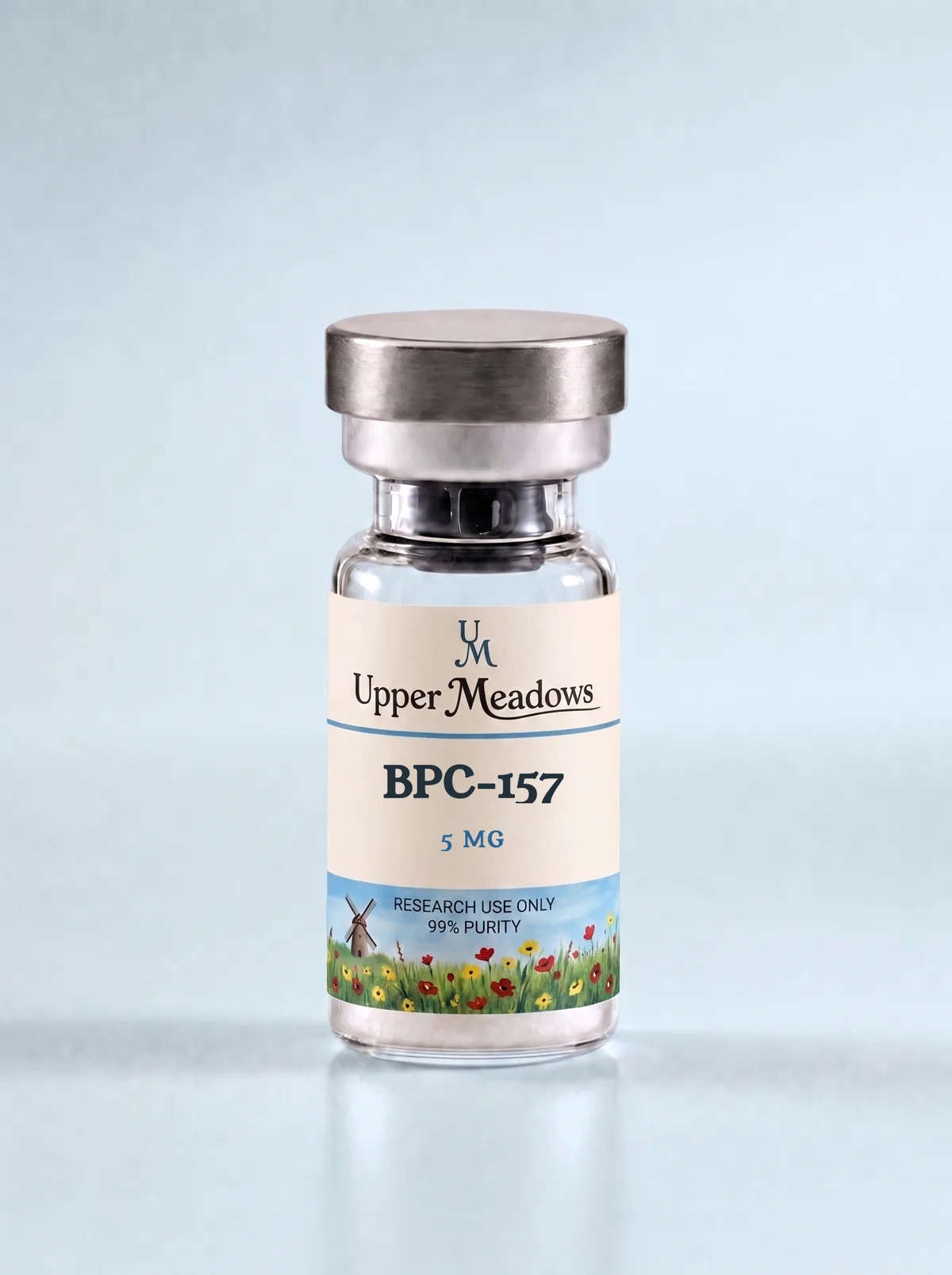
BPC-157 is a synthetic pentadecapeptide catalogued under CAS number 137525-51-0, with molecular formula C62H98N16O22 and a molecular weight of 1419.56 g/mol. It is supplied as a lyophilized powder for laboratory research use and is not for human use. The name reflects "Body Protection Compound," referencing the sequence's original identification in early studies of gastric juice proteins, though the research compound itself is a defined synthetic entity independent of that biological source.
This FAQ answers the most common identity and specification questions researchers have about BPC-157, then turns to a subject that gets far less attention in general compound overviews: what actually happens to this material in storage, how its lyophilized-state stability is maintained through shipping and long-term hold, and how a researcher can verify that a stored batch is still what the label says it is. Storage and handling determine whether the molecular identity confirmed at the point of manufacture still holds true at the point of use — a question that matters as much as the initial specification.
What is BPC-157's molecular identity, and how is it verified analytically?
BPC-157's molecular identity is confirmed through two complementary analytical methods documented on its Certificate of Analysis: high-performance liquid chromatography (HPLC) for purity, and mass spectrometry (MS) for identity confirmation against the theoretical molecular weight of 1419.56 g/mol. Upper Meadows supplies BPC-157 at a minimum purity of 99%+ by HPLC, with each batch documented on a Certificate of Analysis covering both the chromatographic purity profile and the MS-confirmed molecular weight.
These two tests answer different questions. HPLC purity establishes what proportion of the sample is the intended compound versus synthesis-related impurities or degradation products. Mass spectrometry confirms that the dominant species detected actually matches BPC-157's expected molecular weight and formula, rather than a structurally similar but distinct molecule. Neither test alone constitutes a complete characterization — a sample can register high HPLC purity while still being the wrong compound, which is why identity confirmation and purity determination are reported as separate, complementary parameters rather than a single combined figure.
How should lyophilized BPC-157 be stored to preserve structural integrity?
Lyophilized BPC-157 is stored at −20°C, protected from light and moisture. The lyophilization process — freeze-drying the compound from solution into a dry powder — removes the water molecules that would otherwise drive hydrolytic degradation of the peptide bonds along the 15-residue backbone. In its dry, frozen state, the molecule's degradation pathways are dramatically slowed relative to a solution-phase environment, which is the entire rationale for supplying and storing research peptides in lyophilized form rather than as pre-dissolved solutions.
Two factors compromise this stability if not controlled: moisture ingress and temperature elevation. Lyophilized peptides are hygroscopic — the dry powder readily absorbs ambient water vapor if the container seal is compromised or opened and left exposed, and that absorbed moisture reintroduces the hydrolytic degradation pathway the lyophilization process was designed to prevent. Temperature elevation independently accelerates degradation kinetics even in the absence of moisture, through mechanisms including deamidation of asparagine and glutamine residues and oxidation of susceptible side chains. Maintaining −20°C storage with an intact, sealed container is the combination that keeps both of these degradation drivers suppressed.
What happens to BPC-157 during a temperature excursion?
A temperature excursion — a period during which the compound rises above its specified −20°C storage condition, whether during transit or a storage equipment failure — does not necessarily cause immediate or catastrophic degradation, but it does shift the compound out of the conditions under which its stability was characterized. The degree of impact depends on both the magnitude and duration of the excursion: a brief rise to refrigerated temperature during a short transit window carries materially different risk than an extended period at ambient room temperature.
The underlying chemistry is straightforward. Degradation reaction rates — hydrolysis, deamidation, oxidation, and aggregation — increase with temperature. Time at elevated temperature is cumulative in its effect: a longer excursion at a given temperature produces more degradation than a brief one, and a higher excursion temperature produces faster degradation at any given duration. This is why cold-chain packaging for peptide shipments is engineered around maintaining a defined temperature band for a defined duration matched to expected transit time, rather than simply keeping the package "cold" in a loosely defined sense. A shipment that arrives with an intact temperature indicator showing no excursion provides direct evidence that the material remained within its validated stability envelope throughout transit.
What container-closure factors affect long-term BPC-157 stability?
The container holding a lyophilized peptide is not a passive vessel — its sealing integrity, headspace composition, and material properties directly affect long-term stability. A properly sealed vial excludes atmospheric moisture and oxygen, both of which drive the degradation pathways described above if allowed to contact the lyophilized powder over time. Vial closures using butyl rubber stoppers with an aluminum crimp seal are standard for lyophilized peptide products because this configuration provides a low-permeability barrier against both water vapor transmission and oxygen ingress across extended storage periods.
Headspace gas composition is a related consideration: vials sealed under an inert atmosphere — nitrogen or argon rather than ambient air — exclude the oxygen that would otherwise be available to drive oxidative degradation of susceptible residues over long-term storage. This is particularly relevant for a compound held in inventory for extended periods before use, where cumulative low-level oxidative exposure over months can be more consequential than the brief thermal exposure of a single shipment. A container that has been opened and reclosed, even briefly, breaks this controlled headspace and moisture barrier and introduces uncertainty into the stability profile going forward — a fact that argues for single-use aliquoting practices determined by the researcher rather than repeated access to a shared working vial.
How is degradation of stored BPC-157 verified analytically?
The same two analytical methods used to confirm initial identity — HPLC and mass spectrometry — are also the methods used to verify whether a stored batch has degraded. A follow-up HPLC purity assay run on a stored sample, compared against the original Certificate of Analysis purity value, will show a measurable decline in the target peak area and a corresponding increase in earlier- or later-eluting impurity peaks if hydrolytic or oxidative degradation has occurred. Mass spectrometry on the same sample can identify specific degradation products by their mass shift relative to the intact compound — a deamidation event, for instance, produces a mass increase of approximately 1 Da per site, which is resolvable on instruments with adequate mass accuracy.
For researchers working with material that has been in storage for an extended period, or material that experienced a documented or suspected temperature excursion, this kind of confirmatory re-testing is the direct way to establish whether the compound's structural integrity still matches its original specification, rather than assuming stability based on storage duration alone. A stored batch that still shows purity and molecular weight consistent with its original Certificate of Analysis provides direct evidence of continued integrity; a batch showing new impurity peaks or a shifted mass warrants exclusion from further use pending investigation.
How do short-term and long-term stability data differ for BPC-157?
Short-term stability data typically covers the transit and near-term handling window — days to a few weeks — and is the basis for cold-chain packaging design and shipping duration specifications. Long-term stability data covers extended storage — months at the specified −20°C condition — and establishes how long a properly stored, unopened batch can be expected to retain its original specification before periodic re-verification becomes advisable.
These are distinct data sets because the degradation kinetics relevant to each timescale can differ. A brief transit excursion is a bounded, one-time event with a defined maximum duration; long-term storage risk accumulates gradually and is more sensitive to container-closure integrity and any deviation from the specified storage temperature sustained over time, as discussed above. Both data types matter for the same underlying question — does the material a researcher pulls from the freezer still match what the original Certificate of Analysis reported — but they answer it at different points in the compound's handling lifecycle, from the moment it leaves manufacturing through however long it sits in a researcher's own storage before use.
How does Upper Meadows document storage and stability for BPC-157?
Upper Meadows supplies BPC-157 as a research-grade lyophilized compound at a minimum purity of 99%+ by HPLC, with mass spectrometry identity confirmation against the theoretical molecular weight of 1419.56 g/mol. Each batch is documented with a Certificate of Analysis.
Specified storage for the lyophilized material is −20°C, protected from light and moisture, in the sealed container as received. This article does not provide handling instructions beyond storage and shipping documentation; determining specific laboratory handling protocols is the researcher's responsibility, consistent with experimental requirements and applicable institutional regulations. Researchers can review the molecular specification, available sizes, and current documentation on the BPC-157 product page, or browse the full research compound catalog at all compounds. All material is intended for laboratory research use only.
This compound is a research chemical intended for laboratory and scientific research purposes only. Not for human use. It is not a drug, supplement, or food product, and is not intended to diagnose, treat, cure, or prevent any disease. Upper Meadows does not sell products for human consumption. Researchers are responsible for compliance with all applicable local, state, and federal regulations.